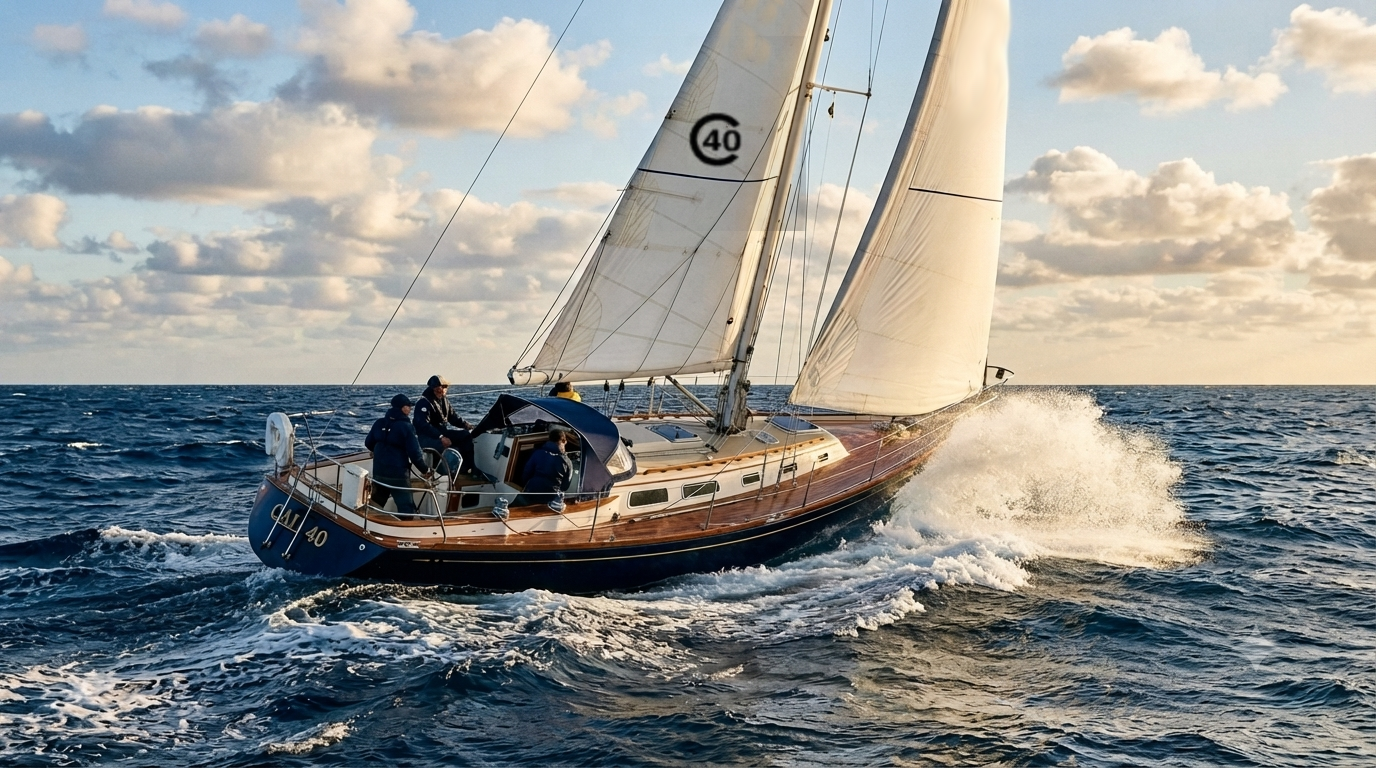
Restoring Hull #96 (Built 1967)
Initial Inspection & Acquisition
The first look at the boat showed what we were getting ourselves in for. The owners were an elderly couple who had owned it for 12 or 13 years. They had done extensive cruising but were now too old (87) to take it off the mooring. I don’t think it had been off the mooring in several years. The husband hated to sell but said his wife refused to go on the boat with him anymore. We bought it on the spot. I promised him we would take him sailing once we had restored it. I had no idea how long that would take. Fortunately, he is still with us and we took the two of them to see it a couple of months ago. We bought the boat in November 2004, took it to a yard where it stayed seven months, then it was finally finished about May of 2007.
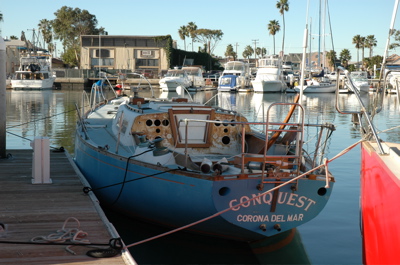
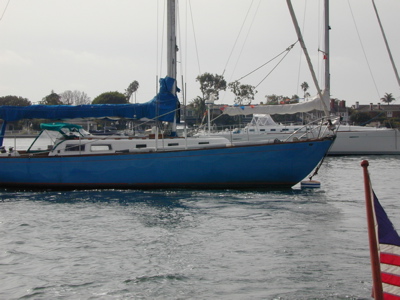 The first look at the boat sitting on its mooring
The blue hull paint was in poor condition. The engine ran but leaked oil. The mast paint was flaking off, the winches were frozen. Most of the gear was inoperable.
Cabin & Galley Overhaul
The interior was in fair condition except for old, mildewed cushions that would have to be replaced. The engine box, a heavy awkward thing at best, had been cut and modified to fit an engine that was too big for the space. It would have to go. There was a lightweight racing ladder that was tubular steel with teak treads. With a small modification, that is our ladder today. The wiring was old and the panel needed replacing. I had a new lightweight engine box built.
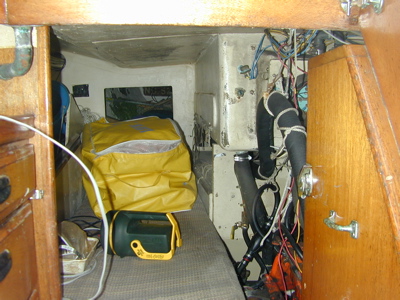 Starboard quarterberth
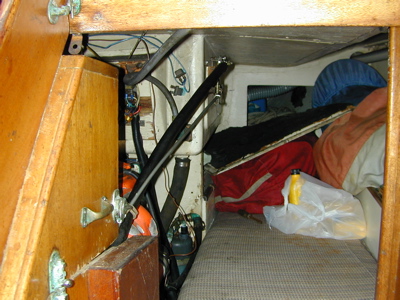 Port quarterberth
The engine controls were old and were on the wrong side for the new engine we ordered. That would have to be switched. Also, I like the Morse sailboat controls, which allow the two handles to be removed when sailing. Unfortunately, Morse doesn’t make them anymore, but I found a set in Minney’s Chandlery.
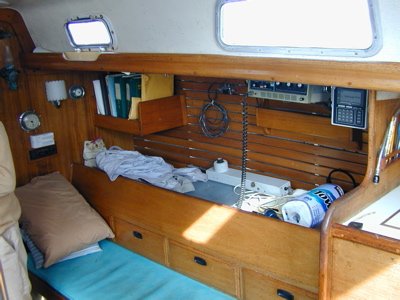 Starboard pilot berth filled with legacy gear
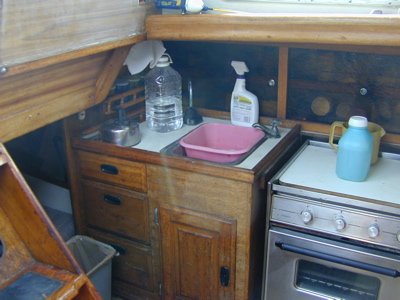 The Galley & CNG Stove
The cabin was filled with obsolete electronics, like the old VHF radio above the pilot berth. The galley was OK and the pressure water worked, but the fittings were old and the water tank looked like it needed replacing. We took the stove home and cleaned it up. It was CNG and, for reasons that are a mystery to me, CNG has fallen out of favor as a stove fuel in boats now. It is far safer than Propane, although it does not have as high a specific heat. Propane requires a sealed box for the tank with electric controls as it is heavier than air and will collect in the bilge if a leak develops.
Getting a new regulator, as the old one had a broken gauge, turned out to be difficult. Ironically, the only source for CNG equipment anymore is the company, Corp Brothers, that was owned by Avery Seaman, the former owner (before it was brought west) of the boat. His family still owns the company and his granddaughter promised to send some photos of the boat when it was in their family.
Deck Stripping & Bulkhead Tabbing
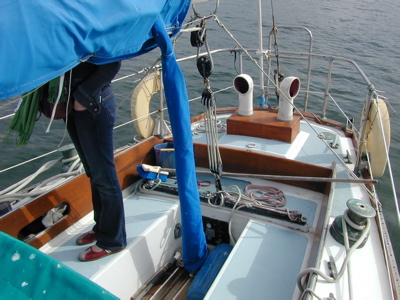 Large lazarette Dorade vents
 Cockpit bulkhead loaded with obsolete instruments
My daughter is standing in the aft cockpit. Behind her are large vents for the lazarette, which are mounted on a Dorade box. They looked like line snaggers. The main sheet rigging was in poor condition and I rerigged that completely. The traveler was replaced with a new Harken model.
The cockpit bulkhead was full of old instruments that no longer worked. They had to go but the holes needed filling. We pulled the mast, intending to refinish it, and hauled the boat. Mike Jr. and I worked for weeks stripping off all the gear. The old engine, a Pathfinder diesel, went to the Boy Scouts. The V-drive was not salvageable and was junked. The winches were chromed bronze and were frozen. I took them home and worked on them, eventually trading them to Minney’s Chandlery for credit on Barient 28 stainless winches. The mast was corroded at the base and under a couple of winch pads so I junked it and bought a new mast. We kept the old boom as it was not original.
“My biggest mistake was not replacing the toe rails right away, but we didn’t know how badly the hull-deck seam leaked until a year later. Mike and I spent months stripping gear and filling holes in the deck... It had survived seven Bermuda races when it was owned by Avery Seaman. George Griffith had sailed four of those races aboard and he later told me that he always arrived a few days early to check out the boat. He brought fiberglass tape and resin with him and usually wound up retabbing some of the bulkheads.”
The Bermuda race, which crosses the Gulf Stream and is usually upwind, is hard on hulls. About 30 years ago, a production boat drove the mast step right through the hull in the severe seas of the Gulf Stream. Many fiberglass hulls are laid up in two halves and later bonded together. That mast compression load split the hulls. The Cal 40 has a steel beam under the step so the load is not on the hull there.
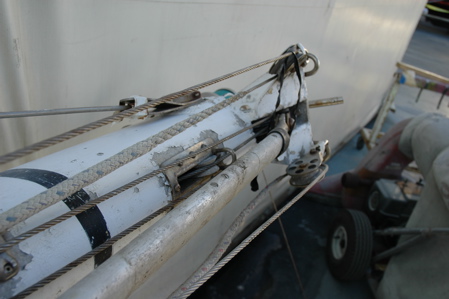 Old wire halyards, sheaves, and reel winch
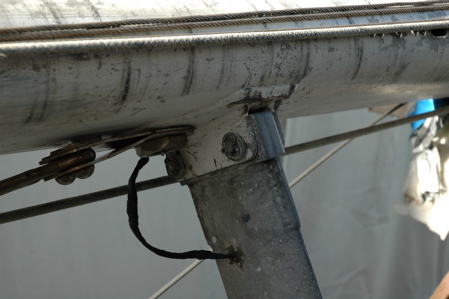 Corroded spreader tangs
The mast was another matter. It was going to be more expensive to refinish it than to replace it since I was going to have all new rigging anyway. The spreader tangs were corroded and the tip fittings could not be opened to change the shrouds.
Repowering & Mechanical Systems
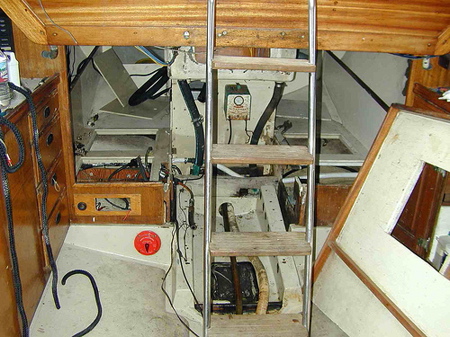 Engine bed with old engine and V-drive removed
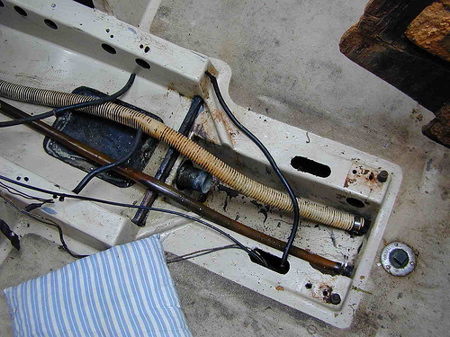 Inner shaft log and packing gland
We took everything mechanical off the boat and, with a couple of exceptions, gave or threw it away. I took the old cushions to a foam place that does good work in San Clemente and they used them for patterns for the new ones.
The engine bed shows both engine and V-drive gone, exposing the inner end of the shaft log. The metal plug to the right is a fill cap for an illegal racing tank that had been installed in the bilge, which we had to cut up with a Sawzall to remove. The engine mounts were too far apart for the new Yanmar 3YM diesel so the yard fabricated new ones from angle extrusions. We stripped out all the hoses and wiring, completely rewiring the boat. For the replacement water tank, the metal shop we chose had built all the tanks for Cal boats back in the 60s when they were across the street in Costa Mesa.
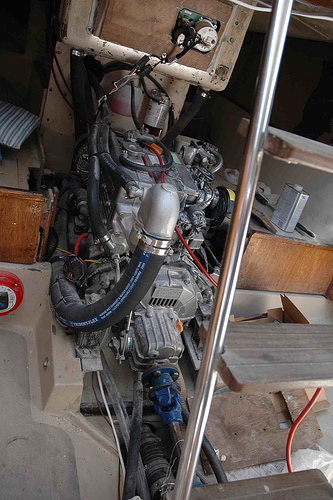 New Yanmar engine installed on custom mounts
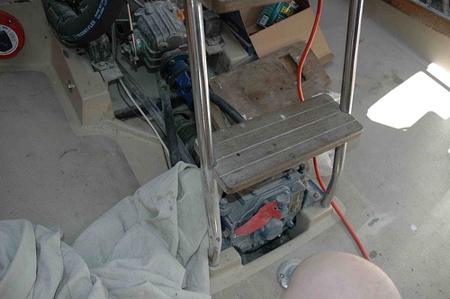 New Walter V-drive unit beneath ladder
The yard made a mistake in ordering the V-drive as the old engine had a 1:1 gear ratio in the transmission. The Yanmar does not have a 1:1 option and had a 1.67:1 gear ratio. Unfortunately, the V-drive had been ordered with a 1.67 ratio as well. It had to be shipped back to Walter and rebuilt as 1:1 and returned.
Bulkhead Repairs & Retabbing
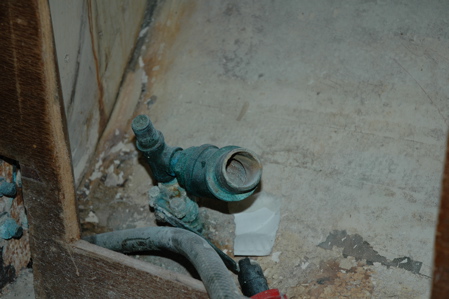 Space beneath head vanity cabinet
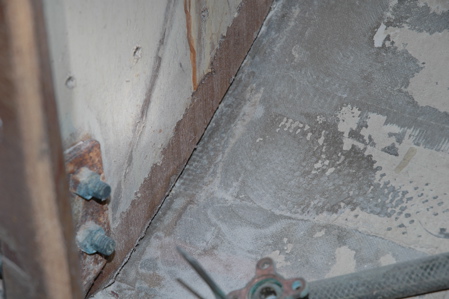 Loose tabbing scraped and prepped
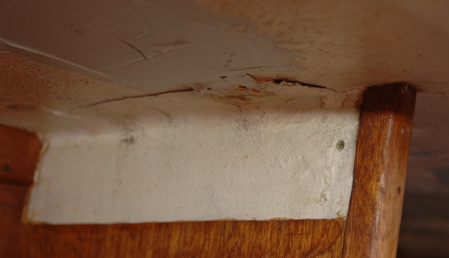 Aft bulkhead tabbing disruption
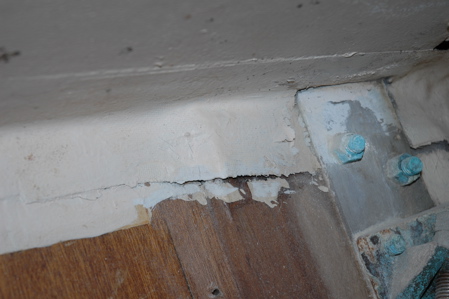 Starboard deck-bulkhead tabbing repair
One primary concern was the tabbing of bulkheads to the hull. Beneath the head vanity cabinet, the port chainplate bulkhead attaches to the hull and to the steel beam via welded steel plates. Loose tabbing was removed, ground down, and replaced before replacing thru-hulls. Similar tabbing disruptions were found near the genoa track and adjacent to the starboard chainplates. All were ground down and completely retabbed.
Electrical Rewiring & Interior Painting
Once structural issues were resolved, the boat was rewired. I copied Fin Beven’s suggestions shamelessly. He sent around a list of his own rewiring project and I used it as a reference alongside Charlie Wing's Boatowner's Illustrated Handbook of Wiring. I ordered a new Blue Sea panel.
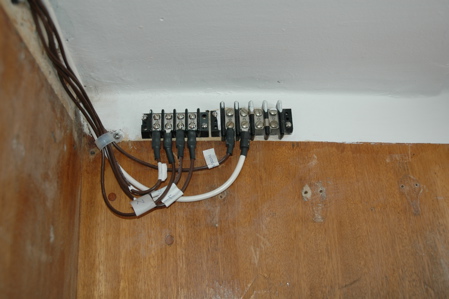 New marine wiring installation
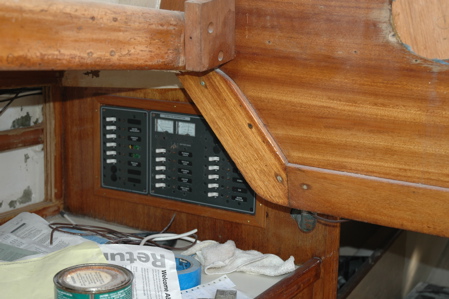 Dual Blue Sea electrical panels
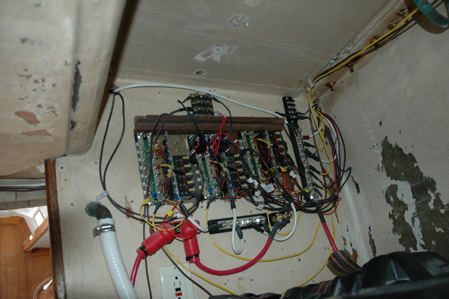 Rear wire harness layout
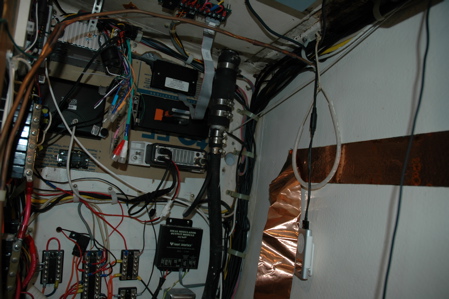 Fin Beven's Radiant panel benchmark
The entire hull was stripped inside, and all wooden battens lining the hull were taken home, sanded, and varnished. The exposed hull was scraped, sanded, repaired, and coated with two coats of Kilz primer and two coats of Sears Kitchen and Bathroom mildew-resistant paint.
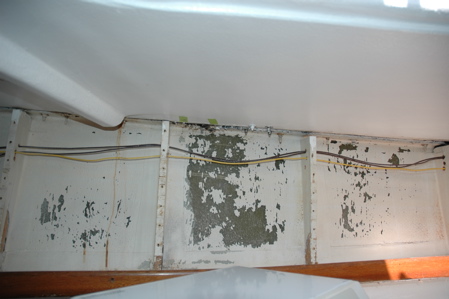 Stripped interior hull surfaces
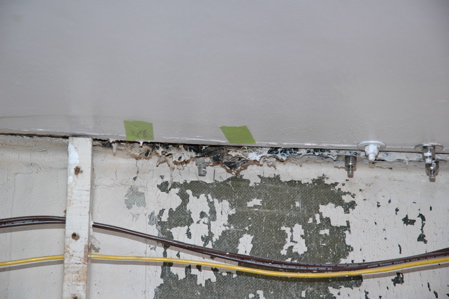 Hull-deck seam leak site (green tape)
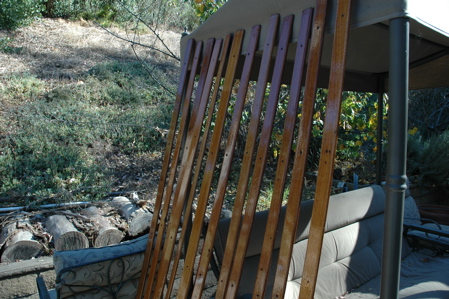 Refinished hull battens ready for reinstallation
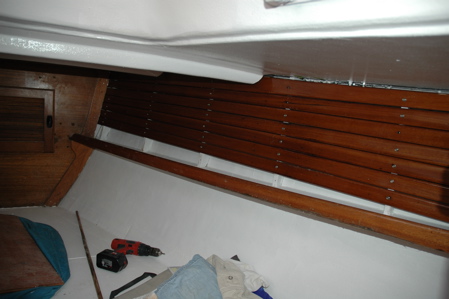 Reinstalling battens in painted V-berth
Painting, Launch & Transpac 2005
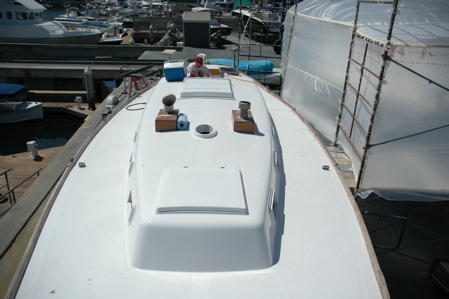 Freshly painted deck structure
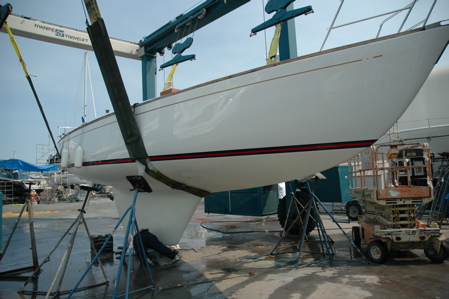 Painted hull with Pettit Vivid White bottom
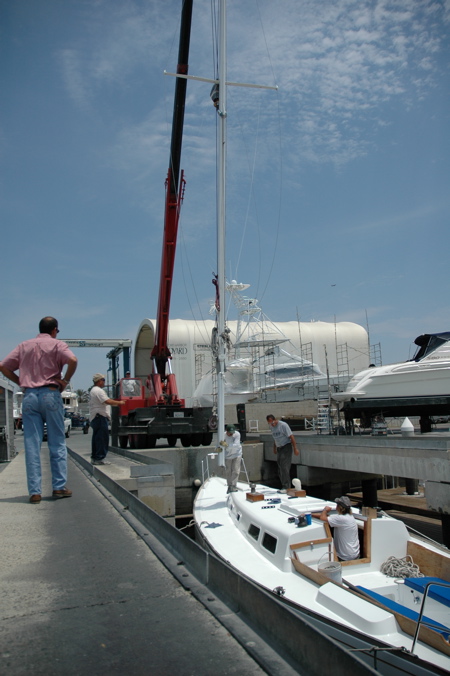 Stepping the new mast
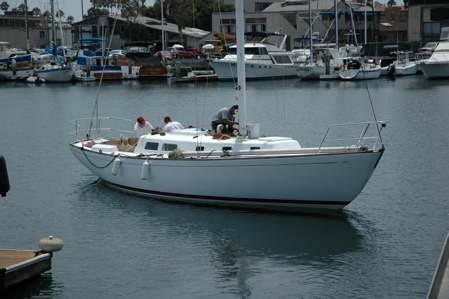 Motoring out for commissioning
The hull is now white with blue-red-blue boot top stripes. For bottom paint, I chose Pettit Vivid White, which Practical Sailor notes as non-yellowing. Bow and stern pulpits were custom made in Costa Mesa, with stanchions by Railmakers.
After stepping the mast, we sublet Wendy Siegel’s slip in Long Beach while she was competing in Transpac 2005, then flew to Honolulu to meet the fleet.
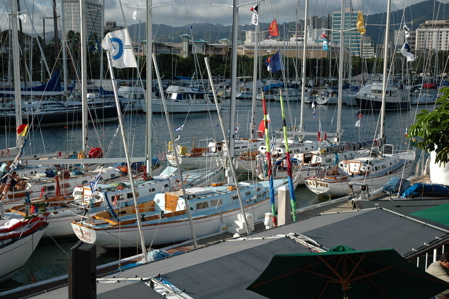 13 Cal 40s rafted at Hawaii Yacht Club (Transpac 2005)
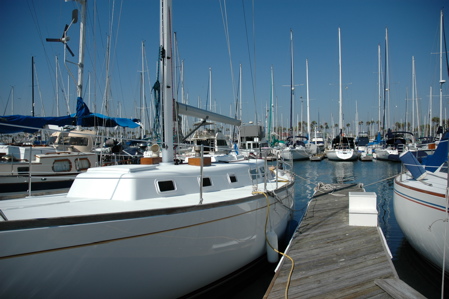 Docked in Long Beach (August 2005)
By the end of 2005, the boat was brought to her permanent home at Cabrillo Marina adjacent to the Los Angeles Yacht Club.
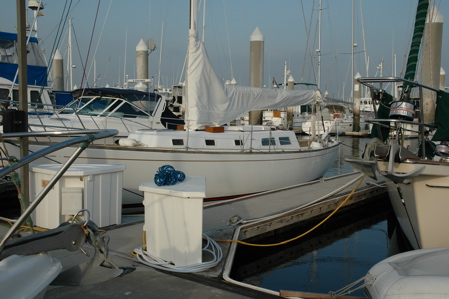 Docked at Cabrillo Marina (December 2005)
The Toe Rail & Seam Rebuilding Project
The toe rail was cracked at the forward end of the cabin on each side, causing a serious leak in the hull-deck seam. The old rails were completely removed and discarded.
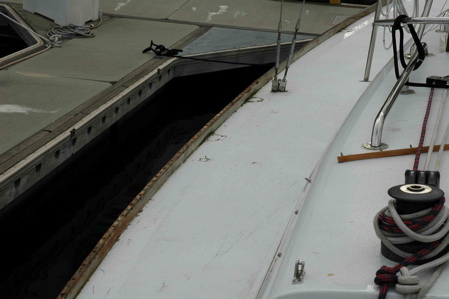 Removing old rails and tracks
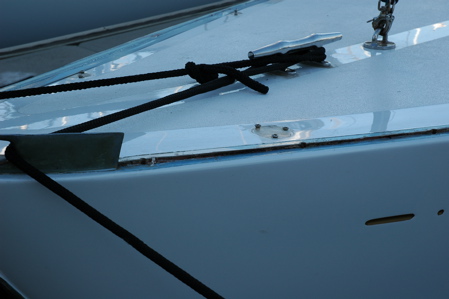 Seam sealed with epoxy putty
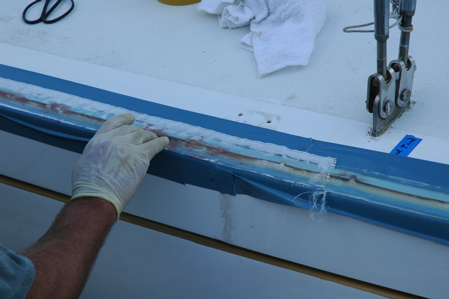 Applying fiberglass tape overlay
 Glassed seam ready for dry fitting
The seam and bolt holes were sealed with epoxy putty and covered with glass tape. New teak rails were milled by the ship’s carpenter to accommodate the raised deck seam, bent to fit the hull curve, bedded in caulk, bolted through, plugged, and sealed with epoxy sealer plus 8 coats of varnish.
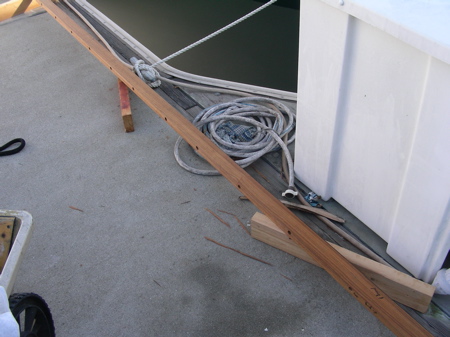 Milled teak rail stock
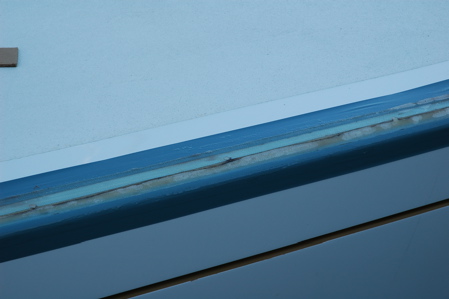 Sealed joint prepped for bedding
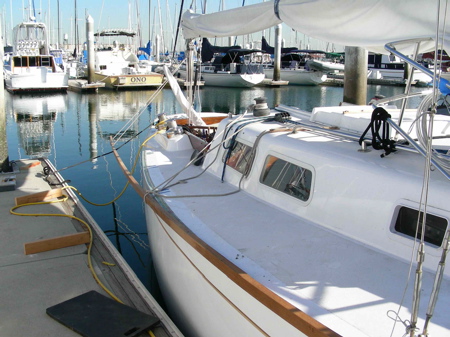 Bending new rail to hull curve
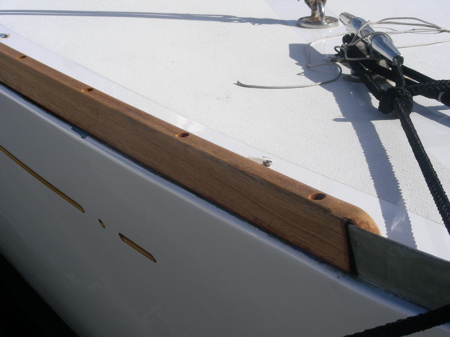 Bedding rail with caulk & bolts
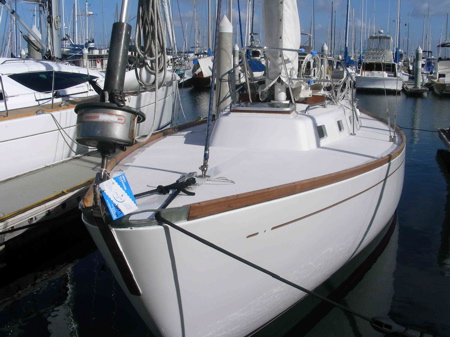 Completed toe rails with shortened polished tracks
Completed Interior & Cruising Setup
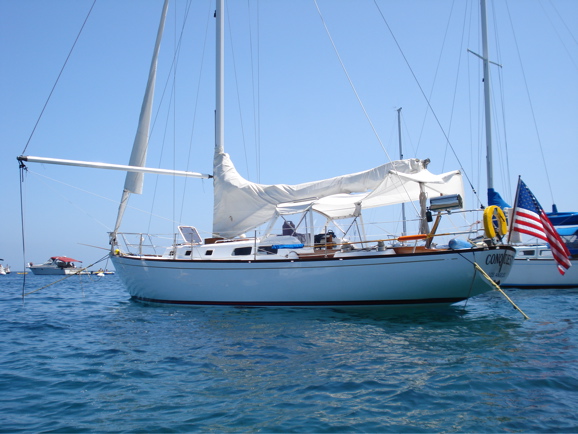 At Catalina Island (Summer 2007) with sunshade & flopper stopper
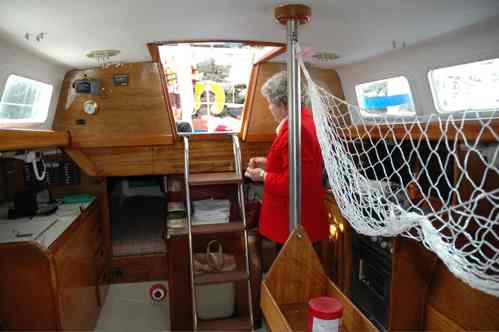 Completed cabin view
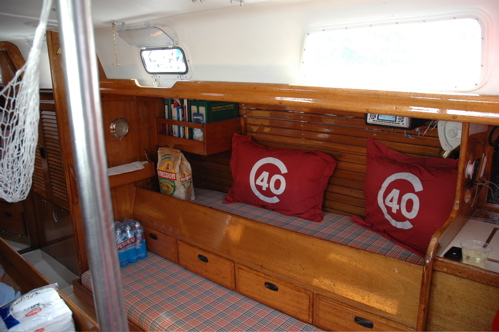 Refinished starboard pilot berth
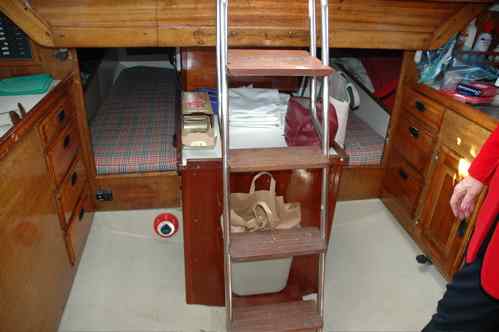 Custom Formica engine box & ladder
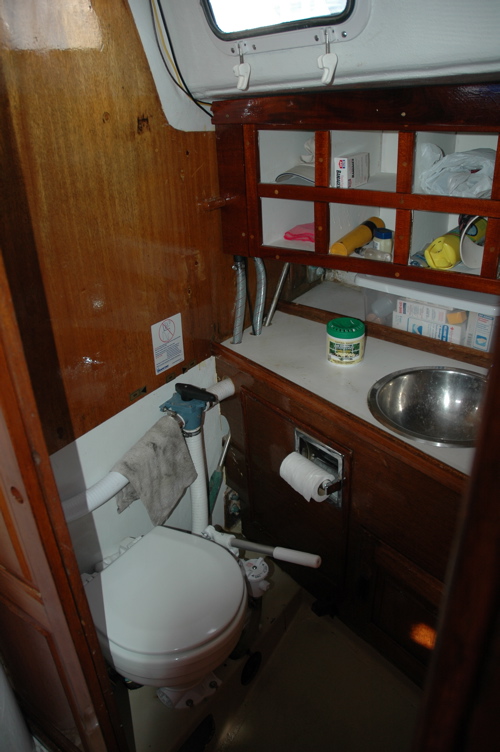 Upgraded head compartment
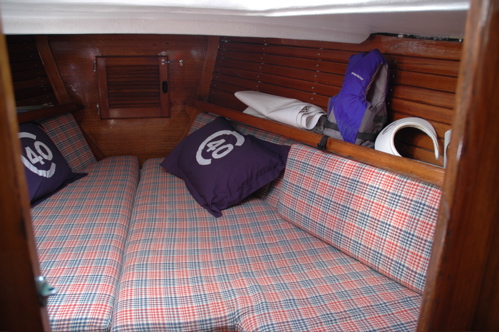 Completed V-berth with custom bolsters & insert
Comprehensive Equipment & Restoration List
Hull #96 (Built 1967) • Seven-time Bermuda Race veteran ( sailed 4 times with George Griffith aboard). Completely restored to original baseline 2004–2005. Refinished in Sterling LP White by Newport Harbor Shipyard; bottom painted in Pettit Vivid White.
Hull & Deck
- Teak toe rails replaced (2007) with hull-deck seam refinished & glass sealed.
- Stainless steel sail tracks shortened & refinished (2007).
- New pulpits, stanchions & lifelines (2005).
- New Lewmar foredeck hatch (2007).
- Mark Plastics custom fixed ports; Beckson Marine opening ports with screens (2005).
- G10 backing plates on all cleats & pad eyes.
- New stainless grab rails on cabin top (2007).
- Blue Naugahyde cockpit cushions & matching tapered backrests (2006).
- Stainless wind scoops for Dorade boxes.
- Dual compasses on teak platforms with LED night lights (rebuilt 2005).
Sailing Gear & Rigging
- Seatek / Ballinger tapered mast with stainless rod standing rigging & carbon fiber backstay (2005).
- Forward lower shrouds & chainplates removed; deck sealed (2005). Baby stay tang on mast.
- 3 jib halyard system, main halyard, topping lift/staysail halyard with mast winch.
- 1983 boom with two reefs & flattener; white Sunbrella mainsail cover (2005).
- Navtec hydraulic backstay adjuster & boom vang (2005).
- 4× Barient #28 cockpit winches, 2× Barient #24 halyard winches, 1× Harken #10 topping lift winch.
- Harken mainsheet track/car with 6-part sheet system (2005).
- New spinnaker pole, track, double foreguy, reaching strut, and high-tech running rigging.
Sails Inventory
- Mainsails: Cruising Main (North 1983); Racing Main (Ullman 2007).
- Headsails: Light #1 (Ullman 2007); Heavy #1 recut for furler (North); Working Jib; #4 Spitfire Jib; Storm Trysail.
- Spinnakers: Symmetrical 1.5 oz, 3/4 oz, and 1/2 oz (North 2003); Asymmetrical Cruising Spinnaker.
Mechanical & Systems
- Yanmar 3YM diesel engine (2005) with 1.67:1 transmission.
- Walter V-drive (1:1 ratio, 2005).
- New prop shaft, cutlass bearing, dripless gland & Martec prop (2005).
- Morse sailboat controls with removable handles.
- New thru-hulls & seacocks throughout.
- New 60-gal stainless water tank with electronic galley gauge (2005).
- New stainless holding tank with macerator pump & deck pumpout (2005).
Electrical & Electronics
- Complete rewiring with dual Blue Sea panels & 110V shore power circuit.
- 3-phase battery charger & 3× deep cycle batteries (2008).
- Raymarine 4000 ST autopilot with laminated tiller.
- Signet knotmeter, depthsounder & water temp gauge.
- GPS with stern pulpit antenna; VHF Radio; AM/FM/CD Stereo system.
- Masthead tri-sector LED running lights, deck/steaming lights, anchor light.
Cabin Interior & Amenities
- New cushions throughout (2005) & refinished teak hull battens.
- CNG stove & oven with new regulator/hoses (2006).
- Original drop-leaf table with gimbaled tray (removable for racing).
- Port/starboard pilot berths with lee cloths; pullout settee berths.
- Custom mahogany plywood engine box with Formica top & removable lift-off access.
- Stainless accommodation ladder with carved teak treads.
Cruising, Outfitting & Safety Gear
- West Marine inflatable dinghy with wood transom & Sunbrella cover.
- 4 HP 4-stroke outboard with stern mount & lifting davit.
- Stern pulpit propane barbecue with Sunbrella cover.
- Stainless flopper stopper with bridle for spinnaker pole.
- Custom Sunbrella dodger with window covers; removable cockpit sunshade.
- Folding stainless boarding ladder with teak treads.
- MOM overboard harness, horseshoe life ring, and MOB poles.
- Coastal life raft (new 2007).
- 12× life jackets & Type 4 flotation cushions.
- Handheld VHF, flares, and chart books.
- Ground tackle: 4 Danforth anchors & 2× 300' nylon anchor lines with thimbles.